
Monuments
At the beginning of 1945, as a result of long-term battles, Piła was completely destroyed.
The city needed to be rebuild almost from scratch.
Therefore only few monuments have survived to this day.
ST. STANISLAUS KOSTKA CHURCH
The oldest church in Piła is St. Stanislaus Kostka Church. The history of this neo-gothic building dates back almost 120 years. The temple (originally a Martin Luther Evangelical Lutheran church) was built in 1896-1897 as a church for Lutherans living in Przedmieście Bydgoskie. It was designed by a church administrator and town councillor Friedrich G. Rademacher. It is a single nave building, in neo-gothic style, built on a rectangular plan, with a domed clock tower. In 1909, a parsonage was built next to the church. The temple served as a Garrison church. Since 1947, it has been a Catholic church, and a parish church since 1987.
 Photo:R. Judycki
HOLY FAMILY CHURCH
A Catholic church erected in 1912-1915, it was built in neo-baroque style, in the form of a cross. On the west side, there are two towers topped with domes and lanterns. Inside, there are three, basilica-like, naves. Below the choir, there is the founder’s plaque, rev. Adalbert Lenz. The temple was originally an auxiliary church. Since 1945, it has been a parish church where pastoral ministry is provided by the Salesians. The pipe organ is the only instrument of this kind in the region. It dates back to early 20th century and represents the romantic style of organ-building, with a timbre - most importantly - that has not changed since the time of construction. The pipe organ has pneumatic tracker with 32 pipes (including 3 reed pipes) and a beautiful, stylised baroque box.

Photo: D. Bogdański
ST. ANTHONY CHURCH
St. Anthony Church houses a seven-metres high sculpture of Christ. It is the only European crucifix carved from one piece of wood. Built in 1929, the church is an interesting example of avant-garde architecture.
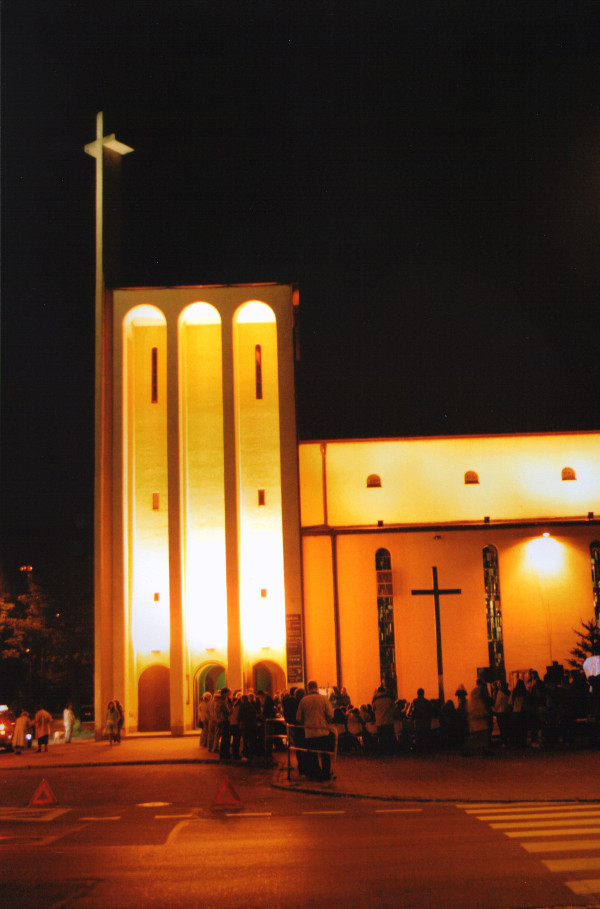 Photo: K. Dęga
STANISŁAW STASZIC MUSEUM IN PIŁA
One of the leading reformers and scholars of the Polish Enlightenment – Stanisław Staszic – was born in Piła. A priest, writer, statesman and philosopher, he became famous as a geologist and an originator of the geological map of Poland. He initiated the construction of a coal mine in Upper Silesia. His house is a valuable museum where visitors can appreciate the accommodation of one of the most prominent figures of the 18th century. The earliest reference to the house dates from
1783, whereas the earliest iconography is from 1878. The house was owned by the Staszic family until 1794 and later on - by other Piła families. It was destroyed in February 1945 and rebuilt in 1947-1948. The museum was established in 1951.
PERMANENT EXHIBITIONS:
- Stanisław Staszic 1755-1826 – presents the life and achievements of Staszic through the museum’s most valuable artefacts (stasziciana).
- Under the sign of Staszic – documents the various forms of Staszic’s presence in the collective memory of Poles in the 19th and 20th centuries: opinions of journalists, social activists and writers, press releases, ephemera, iconography, Staszic notes on earth sciences. The exhibition is presented in the summer months.
THE MUSEUM IS OPEN:
Monday to Friday 9.00 am -4.00 pm
Saturday-Sunday 10.00 am-4.00 pm
On Saturdays, admission is free
ADDRESS:
MUZEUM STANISŁAWA STASZICA W PILE
ul. Browarna 18
tel. 67 213 15 67
fax 67 215 31 39
www muzeumstaszica.pl
 Photo: B.Chodera
STANISŁAW STASZIC DISTRICT MUSEUM
The District Museum is located within 100 m from the house of Staszic. The building was built before 1878. Its architectural form refers to Italian villa construction. The building is of particular importance for the history of Piła as in 1934 - 1939 it was the seat of the Polish Consulate and the only Polish state-owned facility. After 1945, it was the seat of several institutions, including the District Court. It has been housing the District Museum since 1997. Currently, the museum presents archaeological, ethnographic, historical and art collections, which are presented in permanent and temporary exhibitions.
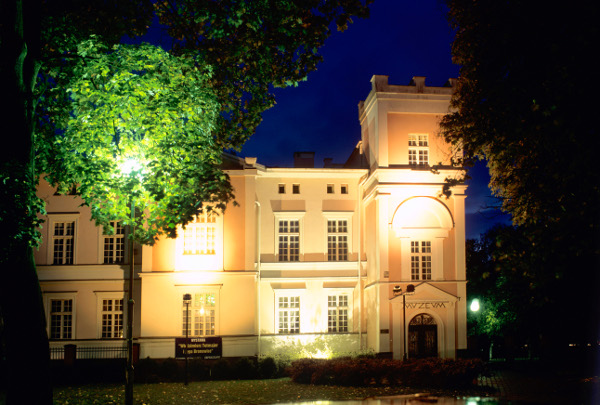
photo:R. Judycki
PERMANENT EXHIBITIONS:
- Furniture and residential interiors from the mid-eighteenth to the early twentieth century –fine arts and applied arts items presents items of Polish and European arts and crafts supplemented by paintings and graphics.
- From the past of Piła and the region – archaeological exhibition presenting the oldest traces of human presence in the region along the Noteć river.
- From the past of Piła and the region – permanent exhibition covering the time from the Middle Ages to the 20th, depicts the history of Piła and the region, presents objects associated with the fate of the three nations who inhabited the area along the Noteć river: Poles, Germans and Jews.
THE MUSEUM IS OPEN:
Tuesday-Friday: 10.00 am-4.00 pm
Saturday-Sunday: 11.00am - 4.00 pm
ADDRESS
MUZEUM OKRĘGOWE IM. STANISŁAWA
STASZICA W PILE
ul. Browarna 7
tel. 67 212 71 37
www.muzeum.pila.pl
ARSENAŁ (ARMOURY BUILDING)
The property was built in 1843-1844 with state funds. It was located at a street, delimited after a great fire in 1834, which took its name, Arsenałowa, after the building (until 1945). The building was built for the Third Battalion of 14th National Defence Regiment (Landwehr), newly arrived in Piła. The unit was joined by the residents of Piła and surrounding districts of Chocież and Czarnków. Next, the two-storey building was elevated by one storey (from the backyard’s side) for the purpose of barracks. Since 1888, Arsenał housed the National Defence District Headquarters. In the 1930s, a Purchasing Office was located here. The building survived the 1945 city fights in good condition. After the war, Arsenał was the home to the family of Władysław Janicki, who opened there the first post-war photography lab in Piła, Foto-Lux.
BORUSSIA LODGE BUILDING,
CURRENTLY USED BY WSG
The property was built before 1823 and it was intended for the Piła Masonic Lodge established three years earlier, which adopted the name of Borussia St. John’s Lodge. The fraternity members were many famous and influential Piła residents, such as Gustav Eichstädt, printer and publisher of “Gazeta Pilska”, Max Popp, architect, and Gustav Wolff, Piła’s Mayor. Behind the building, along the current Al. Niepodległości, there was an expansive garden belonging to the fraternity. The seat of the lodge was the place were charity balls were held, of which the income was spent on various social goals. During World War I, the building housed field hospital. The hospital burnt down in 1915. After the end of World War II, the building was the seat of several institutions, including Liceum Medyczne Pielęgniarstwa (Medical School of Nursing) and Państwowa Szkoła Medyczna Instruktorów Higieny (National Medical School for Health Instructors). Today, it houses Wyższa Szkoła Biznesu (Piła Academy of Business). The building is now the oldest facility in the city (next to the Staszic’s house) and one of two which, before 1945, constituted the buildings of the Old Market Square.
ADDRESS:
Al. Niepodległości 2
RAILWAY STATION
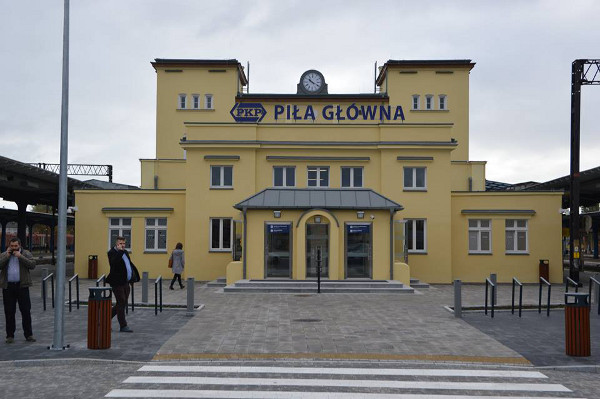
The origins of railway in Piła date back to 27 July 1851, when a railway line Krzyż - Piła - Nakło – Bydgoszcz was launched. It was a part of the Prussian Eastern Railway route. It is then that the first station building was erected, whose exact position unfortunately we do not know. In subsequent years, new rail links were launched to Złotów (1871), Poznań and Szczecinek (1879), Wałcz (1881) and Czarnków (1913). Piła became a junction station. The present building of the main railway station was built in 1870-1874. It is a multi-storey building with four towers. The main entrance was located on the west side of the station, and in 1902-1903, a tunel connecting the station with the city was made there. Between the railway lines towards Tczew, Bydgoszcz and Poznań, two roundhouses were built, along with a buildings complex required to operate steam locomotives. In 1917 and 1918 Piła was passed through by J. Piłsudski and I. J. Paderewski. These events are commemorated by a plaque mounted in the station lobby. On 9 February 1945, the railway station was captured by the Soviets. After the city fights had been brought to a close, the station was reopened due to its strategic importance. In 2015 the station was renovated.
ROUNDHOUSE
The most valuable of the surviving industrial architecture monuments in Piła is the roundhouse with adjacent buildings. It has been permanently inscribed in the landscape of the city. The building, surviving in its original form, is now the only of This kind in Poland and one of the few in Europe. The roundhouse facilities complex has been covered by preservation maintenance. In the late 1980s and 1990s, the roundhouse served as a place for unused locomotives, coal-cars and as a workshop, where future railway mechanics were trained.